The catalogue defines what can be chosen; the specification defines what was chosen
An options catalogue answers a different question than an order does. The catalogue on this site lists exterior hardware, interior equipment and interior colour schemes — the components that can be fitted into the space of a chosen body, combined freely per order. It is a menu, not a commitment. The document the factory actually builds against is the written specification returned at stage 01 of the process, which names the model and the options that apply. The freeze is the moment that document is confirmed line by line. Everything after it — the quotation, the production run, the pre-shipment inspection — builds against that text, not against the emails and conversations that produced it.
For a first-time importer this is the most useful distinction in the whole ordering process: browsing the catalogue is free and reversible, while the confirmed specification is the point where decisions become commitments. The freeze is not an administrative formality — it is where a programme stops being an intention and starts being an order.
The lines that make up the freeze
The stage-01 specification runs on what you send: the pickup details (make, model, generation, bed or chassis dimensions), the destination market and the equipment list. What comes back — and what a buyer should expect to confirm line by line before treating the specification as frozen — covers the decision set below.
| Specification line | What it fixes | Where it is decided |
|---|---|---|
| Model and construction | The body itself — pop-top, hard-top or canopy, in welded aluminium or FRP sandwich composite, made to the bed or chassis dimensions of the pickup | Series and model pages; fitment is confirmed before anything else |
| Lift mechanism | Manual lifting with spring or hydraulic assist as standard on pop-tops; electric scissor lift optional, and recommended on the larger flat-deck and residence bodies | The roof-lift decision, made at specification time |
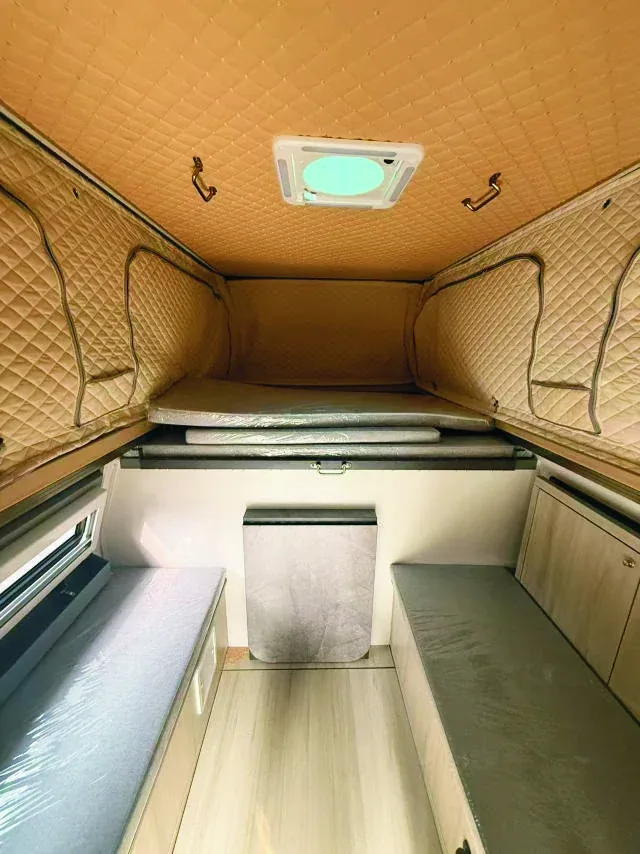
| Equipment level | Interior equipment — fridge, sink and stove unit, bathroom module, dinette, tables, lighting, monitoring — configured per order within the chosen body | The interior equipment catalogue |
| Exterior identity | Body colour, graphic livery and window count; the catalogue models define the construction, the exterior identity belongs to the buyer | The OEM exterior-identity options |
| Branding and artwork | Logo and decals applied at the factory, plus packaging, manual and warranty wording in the buyer brand | The private-label programme |
Read as a whole, the table is a boundary. Everything in the first lines is fixed by the model chosen, and everything in the identity lines is yours by default. The freeze works because each line has one owner — the model decides construction, the buyer decides identity — so no line is left to drift between the two sides of the negotiation.
What builds against the frozen document
The reason to freeze carefully is that three downstream stages all treat the specification as their input. The quotation is issued against the confirmed specification, the quantity and the destination port — so an ambiguous line in the specification becomes an ambiguous line in the price. Production starts against the approved specification and artwork, with progress records at the agreed checkpoints, so what is being built mid-programme is the document. And the pre-shipment inspection, carried out by your own inspector or a third-party company before loading, checks the units against the same reference.
The freeze also has a memory. For repeat programmes the specification and artwork are kept on file, so a follow-up order is produced to the same standard without re-approval. That only works if the first specification was worth keeping: a document full of unresolved lines produces a follow-up order that inherits them.
Why the late change is the expensive kind
Every stage downstream of the freeze holds the specification as its input, so a change after the freeze does not edit one document — it reopens the chain. A changed equipment line re-prices the quotation. A changed colour or livery reopens artwork that may already be approved in writing for a private-label programme, where artwork is confirmed before production starts. A changed destination market reopens compliance, because the documents that can be supplied for a configuration are confirmed against the market before the order is committed.
None of this means changes are impossible; it means each one is priced and rescheduled against the order rather than absorbed. The discipline that avoids the cost is settling, before the freeze, the three inputs that drive it: the vehicle list, the destination market and the equipment level. Those are buyer decisions, they cost nothing to make early, and every one left open past the freeze converts into rework.
The specification-freeze checklist
- Send the pickup details (make, model, generation, bed or chassis dimensions), the destination market and the intended equipment list — these three inputs drive the returned specification.
- Read the returned written specification line by line: model and construction, lift mechanism, equipment level, colours and windows, branding and artwork.
- Mark every line as chosen, deferred to the options catalogue, or not applicable to the model — an unmarked line is the seed of a late change.
- Name the destination market with the specification, so compliance documents are confirmed before the order is committed.
- Treat the confirmed specification as the trigger for the quotation — freeze first, then quote against quantity and destination port.
- Expect production records and the pre-shipment inspection to reference the document; raise questions at the checkpoints, not after loading.
- For repeat programmes, keep the specification and artwork on file so the follow-up order is confirmed rather than re-specified.