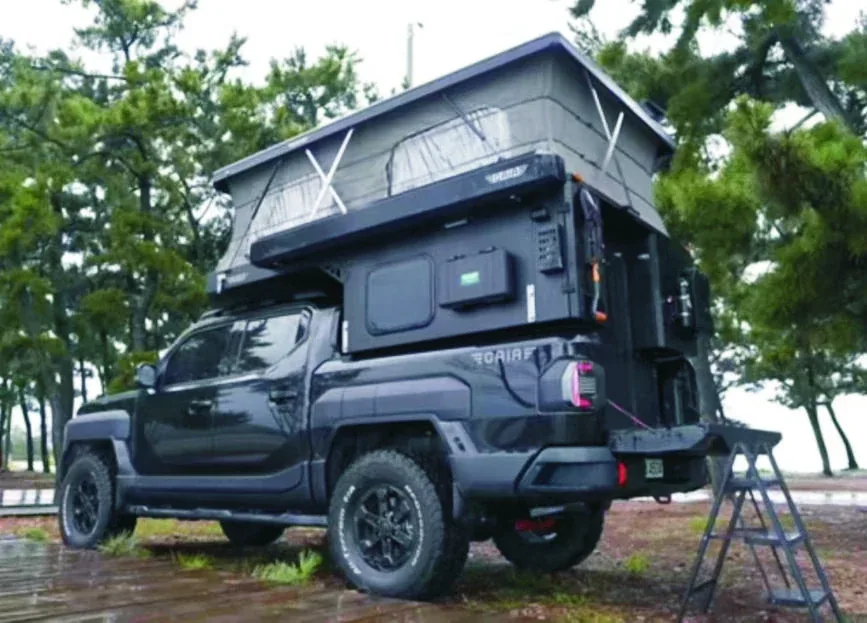
The short answer
A camper body is sold in two halves, and most first-time buyers read them as one. The first half is the standard list: the body construction, the roof, the window arrangement, the storage and the mounting hardware that make a T2 a T2 rather than a T3. The second half is the options catalogue: lift upgrades, roof and camp equipment, interior functions, interior colour and exterior identity, all chosen per order.
The split is not marketing padding. It is the reason two quotations for what looks like the same unit can differ by a page of lines — and the reason the cheaper quotation is often a shorter list rather than a better price.
Two lists, two different jobs
The standard list exists to define the model. It is deliberately short, and it is where the differences between models actually live: the T1 and T2 carry two rear toolboxes as standard, the T3 does not; the T1 and T2 have one outward-pushing window plus an expansion compartment, while the T3 and T4 carry dual side windows instead; the T5 roof canvas has three windows where the rest of the pop-top range has four.
The options catalogue exists to define the order. It is organised the way a buyer actually chooses — what is mounted on the body and roof, what is fitted inside, and what the interior looks like — and almost nothing in it changes the model itself. A fridge, a bathroom module or a wraparound awning does not make a body a different body; it makes it a different unit for a different customer.
What is standard, model by model
The table below is the published standard list, model by model. Where a cell says the item is not in the standard list, it is either quoted as an option or confirmed when the specification is written — it is not included by default.
| Model | Standard body and roof | Standard windows | Standard storage | Mounting |
|---|---|---|---|---|
| T1 Off-Road Sloping | Welded all-aluminium body with sloping front; pop-top canvas with four windows | One outward-pushing window and one slide-out expansion compartment | Two backpack-style toolboxes | Mounting hardware |
| T2 Regular Flat | All-aluminium flat-front body; pop-top canvas with four windows | One outward-pushing window and one expansion compartment | Two backpack-style toolboxes | Mounting hardware |
| T3 FRP Soft-Lift | FRP sandwich composite body; pop-top canvas with four windows | Dual outward-pushing side windows | Not in the standard list — toolboxes are an option | Mounting hardware |
| T4 Flat-Deck | Flat-deck body for flatbed pickups and light trucks; pop-top canvas with four windows | Dual outward-pushing side windows | Not in the standard list | Mounting hardware |
| T5 Residence | Frame-mounted residence body; pop-top with three windows | Outward-pushing windows on both sides | Rear toolbox | Mounting hardware |
| T6 Hard-Fold | Aircraft-grade aluminium body; hard-shell folding roof | Not listed per model — confirmed per order | Not in the standard list | Mounting hardware and interior lighting |
| H1 / H2 Hard-Top | Fixed hard-top in FRP sandwich panels (H1) or one-piece welded aluminium (H2) | Two to three outward-pushing windows per side, count adjustable | Not in the standard list | Mounting hardware |
| C1 / C2 Canopy | All-aluminium high cover with FRP hard-shell (C1) or canvas (C2) roof tent | Left, right and rear wing windows; four tent windows when raised | Canopy cargo area | Mounting hardware |
| R1 / R2 Roof-Top Tent | Hard-shell tent, design A or B | Not listed — the shell designs open differently | Not applicable | Mounting kit, mattress and telescopic ladder |
Two consequences follow. First, the standard list is structural: canvas with windows, a hard shell, a canopy and a roof tent are four different products, and no option turns one into another. Second, the list is short on purpose — which means the interior of a standard unit is essentially empty until the options are chosen.
What the options catalogue actually decides
The catalogue has two halves and they behave differently. Body and roof hardware decides how the unit works outside the cabin:
- Roof lifting: manual spring-assisted lift is standard on the pop-top range, hydraulic struts assist and hold the roof section, and an electric scissor lift is available on most models and recommended on the larger T4 and T5 bodies.
- Roof equipment: a drag-reduction roof box, with or without an LED searchlight, or a roof rack.
- Camp hardware: a wraparound awning, a shower tent, and a roof-mounted or split-system air conditioner.
- Body hardware: a camper door with a push-out window section, tie-down strap anchor points, an exterior charging connector and additional canvas windows.
- Space: a slide-out expansion compartment, on the models that offer it.
The interior half is where the unit becomes sellable to a specific customer. The catalogue covers lighting and ambient lighting, a bidirectional exhaust fan, a compressor fridge, a combined sink and gas stove unit or a stainless sink with a cover plate, a portable toilet or a full bathroom module with shower rail, retractable shower head and floor drainage, folding and height-adjustable tables, a facing booth dinette, a slide-out expansion space and a monitoring display.
Then come the two identity decisions. The interior finishes in one of four published colour schemes — white, wood, cream grey or olive wood. The exterior is set per order: body colour, graphic livery and window count, with artwork approved in writing before the units are built.
Four places where two quotations stop matching
When a buyer sends two suppliers the same brief, the differences usually appear in the same four lines.
- The lift line. A quotation reading manual lift and one reading electric scissor lift are not the same unit, and on a large roof section the second is not a detail. Decide the lift against the model and its roof section before comparing anything else.
- The storage line. Rear toolboxes are standard on the T1 and T2 and an option on the T3. If the comparison sheet does not name them, one quotation can look cheaper while carrying fewer parts.
- The window line. The pop-top canvas carries four windows on most models and three on the T5, and window count is adjustable on the hard-top range. A window count written as a range is a decision that is still open.
- The interior line. An equipment list that says kitchen is not comparable with one that names the sink, the stove, the table, the lighting and the ventilation. In an interior, the unnamed item is the missing item.
Normalising two quotations
Put both documents through the same five steps before you compare a single figure.
- Write the model and the construction route on both, so a FRP body is never compared with a welded aluminium one.
- Copy the standard list beside the model and tick what each quotation actually contains, including storage and mounting hardware.
- Group the remaining lines into body and roof hardware, interior equipment and exterior identity. A line that fits no group is usually a service, not a part.
- Mark anything written as a range, a brand name or to be confirmed — those are open decisions that will change both the build and the price.
- Only then read the commercial lines. Price and lead time are quoted against the confirmed specification, the order volume and the destination port, so neither figure means anything until the two specifications match.
What stays custom, and what it costs to leave open
Dimensions, interior layout, colour, livery, equipment level and branding are produced to the customer's requirement: the catalogue defines the construction, the order defines the identity. That is the point of a factory-direct programme, but every item left open at specification stage returns as a question during production, when changing it is expensive.
Before you send the RFQ
- Model and construction route, written down for each line of the order rather than for the order as a whole.
- The lift mechanism per model, because the range does not share one answer.
- Roof equipment and camp hardware as separate lines, so the quotation can be read against them.
- Interior equipment named item by item: cooking, washing, toilet or bathroom module, seating, tables, lighting, ventilation and monitoring.
- Interior colour scheme and, if the unit carries your brand, body colour, livery and window count with artwork attached.
- Destination market and destination port, so the compliance position and the quotation are both issued against real conditions.
A camper programme is built out of two documents: a model list that says what the product is, and an option list that says what this order is. Keep them apart in your own files and neither a quotation nor a supplier can blur them. Send us the vehicles and the use case, and we will return the standard list and the option list side by side for the models you are considering.