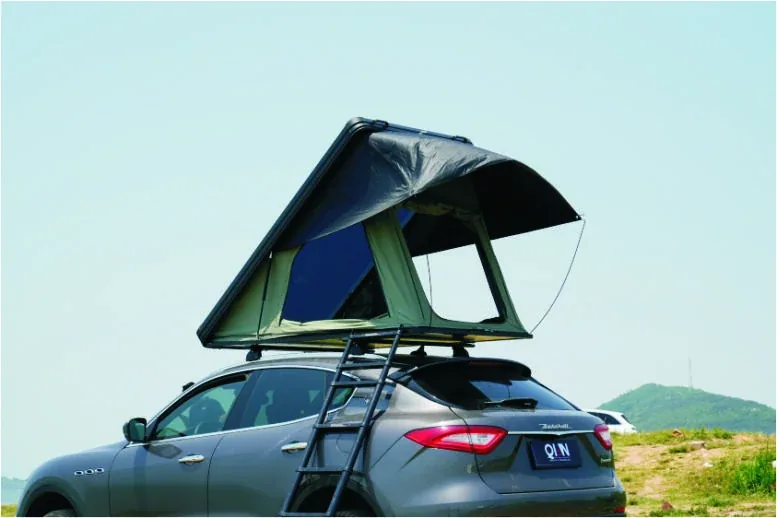
The one product that fits the customers campers do not
Every body in the camper range is made to a specific vehicle. The tent is not. It mounts to the roof rack or crossbars of any vehicle with a roof load rating to suit — the SUV, the wagon, the van and the sedan, not only the pickup — which is why the tent line reaches the widest customer base of anything a camper dealership can stock.
That is the cross-sell in one sentence: a camper dealership has already paid for the floor space, the sales conversation and the customer traffic that capable-vehicle owners bring. The roof tent converts customers from that same traffic who will never order a body, and it does so without a second supplier, a second shipment or a new category of after-sales work.
Three customers, one second SKU
The attach works because the tent answers a different objection for each customer type walking into a camper dealership. None of the three conversations requires a new product story — the tent is the same R1 or R2 hard-shell unit in every case, and the only variable is which vehicle it ends up on.
| Customer | What the roof tent answers | What to confirm at the counter |
|---|---|---|
| The customer who will not modify the daily vehicle | A sleeping unit that mounts to a roof rack or crossbars and comes off again — the vehicle stays unmodified, no bed occupied, no drilling | Roof rack or crossbars present and rated; roof load rating to suit |
| The camper buyer planning a second vehicle | The household adds a second sleeping solution for the other car without ordering a second body | The rack and roof load rating on that second vehicle, not the truck the camper is on |
| The SUV or towed-trailer customer the camper range does not reach | A product from the same catalogue they can actually buy, at the entry point of the range | R1 or R2 by opening format and packed height; the rack the vehicle already carries |
| The budget-limited capable-vehicle owner | The lowest-commitment way into the category the dealership sells, with the option to return for a body later | Shell design preference and the accessories worth adding to the same purchase |
Why the attach is operationally cheap
The commercial mechanics favour the cross-sell as much as the customer logic does. Roof-top tents containerise as compact flat packs — the cheapest item in the range to ship and the easiest to receive. Mixed-model container loads are accepted, so tents ride in the same container as the camper bodies the dealership is already ordering, and MOQ is flexible enough that the tent line can start small rather than as its own order.
Receiving and merchandising are equally short. Each tent ships with the mattress, the telescopic ladder and the mounting kit included, so the standard list is one counter card. The options are a short list as well — ladder, annex and shoe bag, with the shell colour set to your brand under an OEM programme, artwork confirmed in writing before production starts.
The one check that protects the sale
The single technical condition is the roof. Installation requires a roof rack or crossbars as the base, and the vehicle roof load rating has to be confirmed before the order — that confirmation belongs to the vehicle data, not to a published figure. It is one question at the counter, and it is the difference between a fitment that works and a customer coming back with a problem.
The shell itself carries the rest of the counter conversation. Both R1 and R2 are hard shells, so the only fabric in use is the opened section — there is no canvas body to dry out, which is the objection that soft tents raise in wet-climate markets. For a dealership already selling pop-top canvas roofs, being able to point at a hard-shell alternative keeps the conversation inside your range instead of sending it to a competitor.
The cross-sell checklist
- Put the tent on the floor beside the camper bodies, opened — the attach sells on sight, not from a spec sheet.
- Train the attach question: for every camper enquiry, ask which other vehicle in the household camps, and for every non-camper enquiry, ask what the vehicle carries on its roof.
- Confirm the roof rack or crossbars and the roof load rating at the point of sale — the base and the rating belong to the vehicle, so the check happens before the order, every time.
- Use the included list as the counter card: mattress, telescopic ladder and mounting kit ship with every tent, so the customer can picture the full kit in one line.
- Offer the accessories with the tent, not later — ladder, annex and shoe bag attach naturally to the same purchase.
- Add tents to the same container as the camper bodies; mixed-model loads are accepted and flat packs containerise, so the second SKU rides along instead of becoming a second shipment.
- If you retail under your own brand, set the shell colour to your brand under the OEM programme and have the artwork confirmed in writing before production.