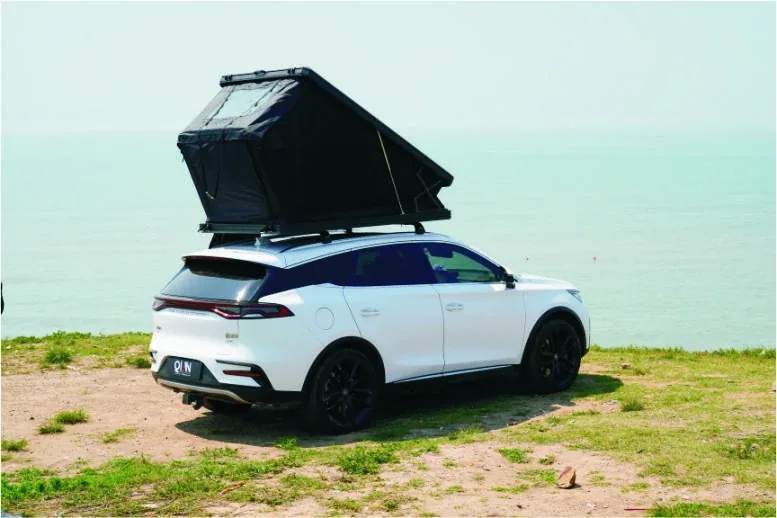
Why this is the range to start with
Every other product in the camper range is made to a specific vehicle. A roof-top tent is not. It mounts to the roof rack or crossbars of any vehicle with a roof load rating to suit, which means a single line serves every customer who walks in — the pickup owner, the SUV owner, the wagon owner and the van owner alike.
For a retailer testing a new category, that removes the hardest part of stocking a vehicle-mounted product: you do not have to guess which vehicles your customers drive before you place the order.
What the two designs actually are
The range is two hard-shell designs, R1 and R2. Both share the same mounting principle and the same included items; they differ in opening format and packed profile. Both are hard shells, so the only fabric in use is the opened section — there is no canvas body to dry out.
| Point | R1 Roof-Top Tent A | R2 Roof-Top Tent B |
|---|---|---|
| Mounting | Roof rack or crossbars (required base) | Roof rack or crossbars (required base) |
| Shell | Hard shell | Hard shell |
| Vehicle fit | Any vehicle with roof load rating to suit | Any vehicle with roof load rating to suit |
| Difference | Design A opening format and packed profile | Alternative opening format and packed profile |
| Shipping | Compact flat pack | Compact flat pack |
| Included | Mattress, telescopic ladder, mounting kit | Mattress, telescopic ladder, mounting kit |
| Options | Ladder, annex, shoe bag; shell colour to your brand | Ladder, annex, shoe bag; shell colour to your brand |
Flat-pack shipping is the commercial argument
Camper bodies ship assembled or in shipping configuration depending on the model. Roof-top tents containerise as compact flat packs, which makes them the cheapest item in the range to move and the easiest to add to an order that is already going somewhere.
That is why they work well as a first line: a retailer can test the category without committing a container to it, and an importer already ordering camper bodies can add tents to the same load as fill rather than as a separate shipment.
What to confirm at the point of sale
The one technical condition is the roof. Installation requires a roof rack or crossbars as the base, so the vehicle roof load rating has to be checked before the sale is confirmed. That check is the difference between a straightforward fitment and a customer returning with a problem, and it takes one question at the counter.
- Does the vehicle already have a roof rack or crossbars, and are they rated for the load?
- Which design suits the customer — R1 or R2 — by opening format and packed height?
- Where will the tent be stored when it is not mounted, if the customer removes it between trips?
- Does the customer want the annex, the ladder or the shoe bag as part of the same purchase?
Selling it alongside camper bodies
A roof-top tent is also a natural add-on for a camper customer rather than a competing product. A dealership retailing pop-top and hard-top bodies can hold one or two tents as a lower-priced entry point into the category, and the same customer base — people who already own a capable vehicle and camp from it — buys both.
Under an OEM or ODM programme the shell colour is set to your brand, and the accessories are chosen per order, so the line can carry your identity rather than the standard range. Artwork and the parts list are confirmed in writing before production starts.
A short checklist for adding the range
- Decide how many of R1 and R2 to carry, and whether they are held in stock or ordered per sale.
- Confirm the roof rack position with your customer base before placing the first order.
- Choose the accessory set you will list as standard and the one you will list as optional.
- Decide whether the shell colour carries your brand.
- Plan the first order alongside any camper bodies so the load is combined.
- Confirm which documents your market requires for the product before the order is placed.