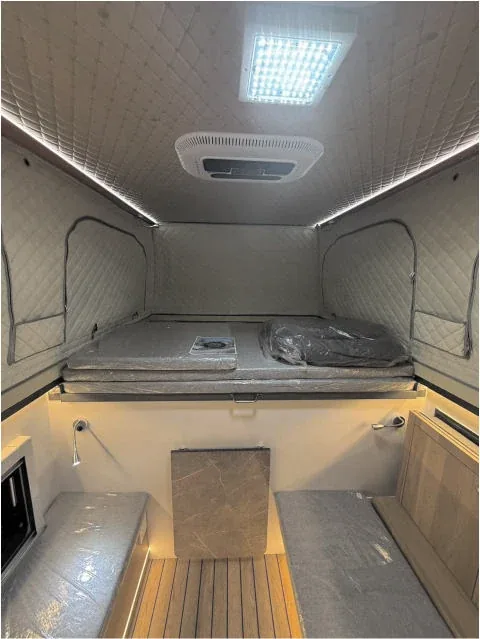
A photo starts the conversation; a demo unit closes it
A dealer can sell from a catalogue for a while. Model pages describe construction, roof principle and window layout, and quotations can be compared line by line. But the questions that decide a camper sale on the floor are physical ones: how much effort the roof really takes to lift, whether the interior feels like the position it is priced at, what the finish looks like under showroom light, and whether the unit will actually sit on the truck the customer drives in. A demo unit is the one stock item that answers all four without a brochure.
The good news for a dealer planning one: a demo unit is not a special product. It is specified from the same options catalogue as any other order, built to the same written specification and produced through the same process stages. What changes is how you choose the line items — each one is selected for what it can demonstrate, not only for what it does.
The four demonstrations a floor model has to carry
Work through the specification with the demonstration in mind and the choices almost make themselves:
| Demonstration | What the customer experiences | What it is specified from |
|---|---|---|
| A lift mechanism working | Watching the roof section rise, and feeling the assist in the mechanism | Manual tent lift with spring assist is standard across the pop-top range; hydraulic struts assist and hold; electric scissor lifting is optional on most models |
| An equipment level at your market position | Opening the fridge, sitting at the dinette, seeing whether the layout matches the price point | Interior equipment configured per order — fridge, combined sink and gas stove unit, dinette systems, bathroom module, lighting and monitoring |
| An interior colour scheme | Judging the finish and how the lighting reads in person rather than on a screen | Four interior colour schemes — white, wood, cream grey and olive wood — with roof light and ambient lighting options |
| The fitment story | Seeing the mounting hardware and hearing that the truck is not cut or welded | Bodies are custom-made to the bed or chassis dimensions of the vehicle, with non-destructive bolt-on mounting that can be removed when the truck changes |
The lift demonstration deserves a deliberate choice. On the smaller bodies, manual lifting with spring or hydraulic assist is the standard mechanism and is entirely adequate — a customer can raise the roof by hand, which is itself a selling point. On the larger flat-deck and residence bodies the roof section is bigger and heavier, and electric scissor lifting is the recommended choice; a demo of one of those units should show the motor doing the work, because that is what the buyer will live with.
One exception to know before you order: the T3 is a manual-only model — the expansion compartment and electric lift are not offered on it. If the demo has to show an electric lift, the T3 is not the body to demonstrate it on.
Match the demo to the position you sell
The range already carries recorded applications that map to retail positions, and the demo unit should sit where your range sits:
- Entry and value markets: the T3, an FRP sandwich-composite value model with dual side windows and a proven manual lift, demonstrates the smooth fiberglass finish at the accessible end of the range.
- Core retail: the T2, recorded for dealer main range, is the all-aluminium flat-front body with the most interior volume in the bed-mounted range — manual lift standard with an electric upgrade available, so it can demonstrate either mechanism.
- Premium: the T5, the largest body bolted directly to the pickup frame with electric lifting recommended and a full equipment list including the bathroom module, demonstrates the near-motorhome interior while keeping the truck; the T6, with its hard-shell folding roof, demonstrates the four-season, no-canvas story instead.
- Cold and wet markets: an H1 or H2 hard-top demo answers the setup objection outright — the roof is fixed, nothing deploys, and the unit is ready to sleep in whenever the customer stops.
For a dealer carrying the full range, one demonstration unit plus the roof-tent line covers every shelf: roof-top tents mount to any vehicle with a roof rack or crossbars, so the same floor space can show the widest-reach product in the range without a second body.
One unit, the same route as the series that follows
MOQ is flexible and depends on the series and shipping format, and mixed-model loads are accepted — so the demo can be a single unit, or a demo paired with a roof tent or two in the same container. More important is that the route is the same whether you order one evaluation unit or a full programme: you send the pickup details, target market and equipment list, a written specification comes back naming the model and the options that apply, and the quotation is issued against that specification, the quantity and the destination port.
That single-unit-on-a-written-specification route is what makes a demo honest. If the floor model is ordered against the same specification as the series that follows, the customer who buys from the demo receives what they saw — and for repeat programmes the specification and artwork stay on file, so the next build matches the demo without re-approval. Branding works the same way: your logo and decals are applied at the factory with artwork approved in writing before the units are built, so the demo can carry your brand from the first unit.
Production gives you the checkpoints to build the story around: progress records arrive during production, and pre-shipment inspection — by your own inspector or a third party — happens before the unit is loaded. A dealer who photographs the build and displays it beside the demo unit has a walk-in answer to the quality question before it is asked.
Demo-unit checklist
- Pick the model from the position you sell, using the recorded applications — not from a feature list.
- Write the demonstration items into the specification: lift mechanism, equipment level, interior colour scheme and dinette system.
- Include the fitment story in the order: send the make, model, generation and bed or chassis dimensions of the trucks your market drives, so the body is made to a real vehicle.
- Choose the lift deliberately — a manual demo proves how easy the standard mechanism is; a T4 or T5 demo should show the recommended electric scissor lift.
- Submit artwork for the logo and decals early, so the demo arrives carrying your brand with the artwork already on file for the series that follows.
- Keep the specification: the quotation is issued against it, and on a repeat order the same document produces units that match the floor model.