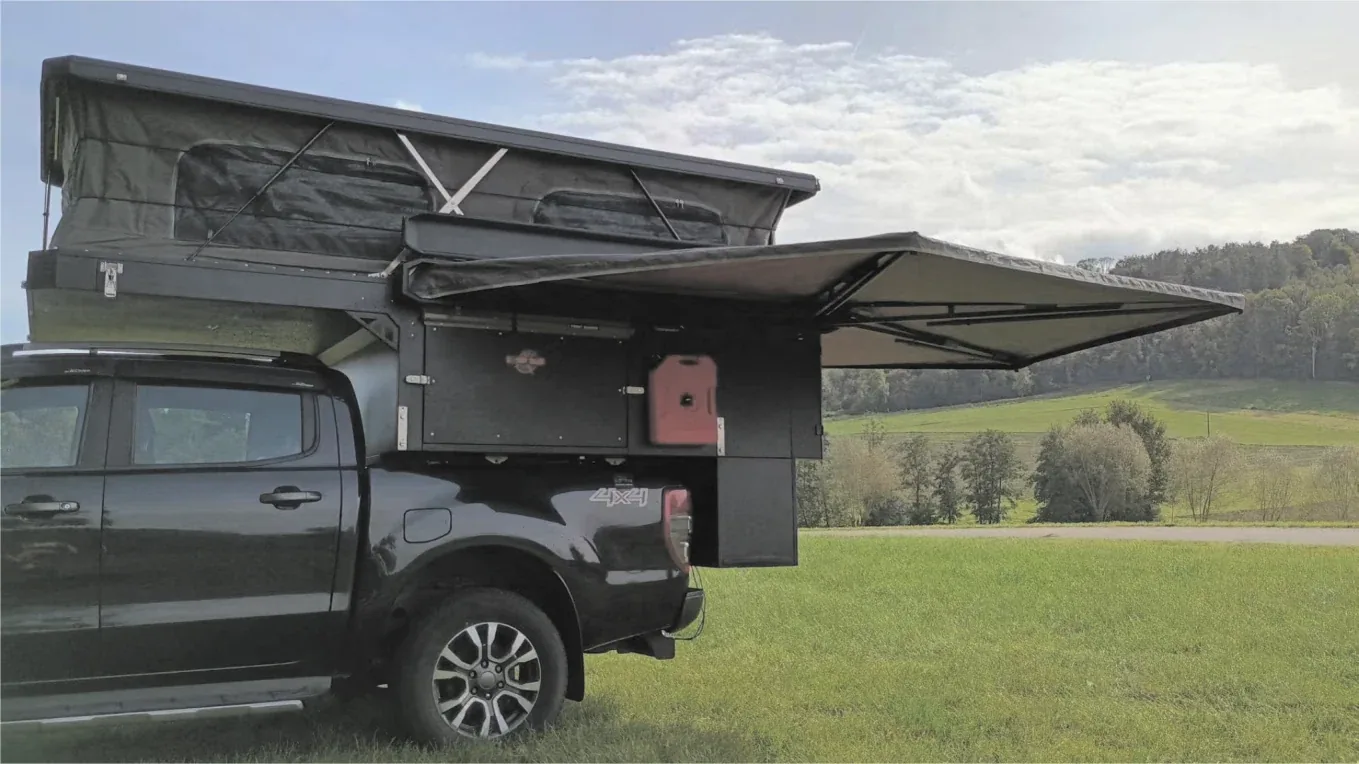
The questions that decide the sale
A pickup camper is a considered purchase, and most buyers arrive with the same five or six questions. The good news for a counter team is that every one of those questions can be answered honestly from what the factory actually does — no figures, no promises and no guesswork required. This guide walks through them in the order customers tend to ask.
Will it fit my truck?
This is the first question, and the honest answer is stronger than a yes: every body is custom-made to the vehicle. What the customer needs to understand is that fitment is confirmed from data, not from eyeballing the bed. Train staff to collect four things before promising anything:
- The make, model and generation of the pickup.
- The bed dimensions, for bed-mounted bodies.
- Flatbed dimensions, if the customer is asking about the T4 flat-deck.
- Chassis dimensions, if the question is about the T5 residence, which bolts directly to the frame.
With those four items the fitment is confirmed before an order is placed, which is exactly what a buyer wants to hear: not a guess, a check.
Will installing it damage my vehicle?
No cutting, no welding on the vehicle. The bodies use non-destructive bolt-on installation, mounting into the bed or onto the chassis without modifying the truck, and a body can be removed again when the vehicle changes. The T5 residence bolts directly to the frame and is likewise reversible.
For a customer who leases the truck or plans to sell it within a few years, this is often the answer that closes the conversation in your favour — say it plainly and let it land.
How hard is the roof to lift?
On the pop-top range, manual lifting with spring or hydraulic assist is standard, and it is entirely adequate for the smaller bodies. Electric scissor lifting is optional on most models and is the recommended configuration on the T4 flat-deck and the T5 residence, where the roof section is larger and heavier.
If you keep a demo unit on the floor, raising the roof is the single most persuasive thing a salesperson can do — the mechanism does the explaining. Match the answer to the customer: a customer who travels with a bad back is an electric-lift conversation, not a reassurance conversation.
What is it made of?
Two constructions, both produced in-house. The all-aluminium bodies are welded as one structure and suit a technical, off-road positioning. The FRP bodies are fiberglass sandwich composite with a smooth painted finish and an insulated core. Neither is a lesser option — construction is an engineering choice per model, not a quality ranking.
The counter version of this answer is one sentence per construction, then a question back to the customer: how and where will you use it? That turns a specification detail into a matching exercise, which is what good retail conversations are.
What happens if something breaks?
Lift mechanisms, windows, hardware and service components come from the same production line as the complete units, and a recommended spares kit ships with the first order a dealer makes. So the honest answer is structural, not sentimental: the parts are not an afterthought, they are made on the same line and supplied alongside the units.
The two questions you should not answer with a number
Price and delivery time depend on the model, the equipment level, the destination and the order volume. A counter that quotes from memory will eventually be wrong. The stronger answer is a process answer: the specification is written first, and the quotation is issued against it and against the order volume — so the number the customer eventually sees is one that matches the unit they are actually buying.
The same discipline applies to figures the factory has not published, such as per-model dimensions and weights, and to certification documents, which are confirmed against the destination market before an order. Teaching staff to say exactly that — confirmed against your vehicle and your market before the order — is more reassuring than an improvised number.
A counter card for staff
- Fitment: custom-made per vehicle — collect make, model, generation and bed, flatbed or chassis dimensions.
- Installation: bolt-on, no cutting or welding, reversible when the truck changes.
- Roof: manual with spring or hydraulic assist is standard; electric optional and recommended on the T4 and T5.
- Materials: welded aluminium or FRP sandwich composite, both made in-house — match to use, not to a ranking.
- Parts: same production line as the units; spares kit ships with the first dealer order.
- Price and delivery: quoted against the written specification and the order volume, never from memory.
- Dimensions, weights and compliance documents: confirmed against the vehicle and market before the order.