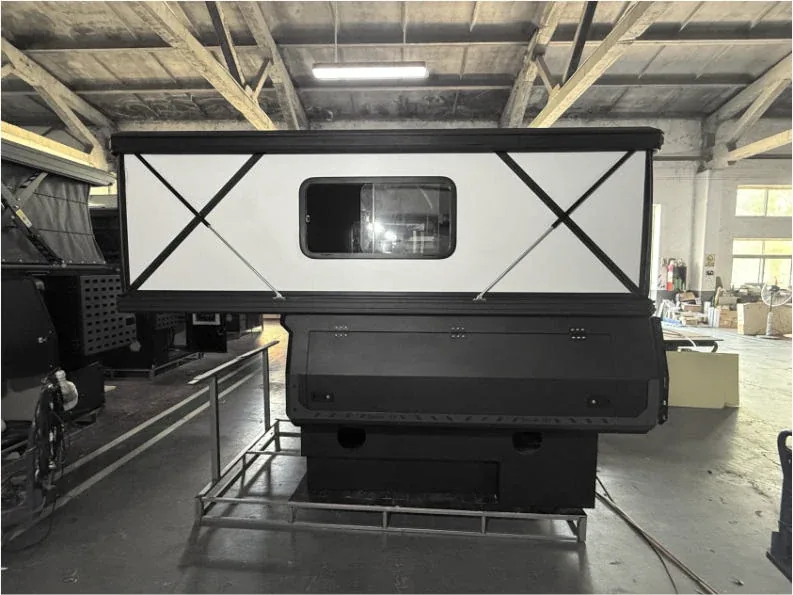
The short answer
A pop-top body exists so the vehicle can travel low and open tall. The mechanism that lifts the roof section is therefore part of the product, not an accessory bolted on afterwards, and it is decided at specification stage together with the body it belongs to. Two configurations are offered: manual lifting with spring or hydraulic assist, which is the standard across the range, and electric scissor lifting, which is optional on most models and recommended on the two largest bodies.
For a dealer writing one line into a catalogue this matters less than the body choice. For an importer building a range, or a rental fleet standardising units across many vehicles, it is the specification line that decides how a customer opens the roof and how quickly the unit is handed over between users.
What each mechanism actually decides
The mechanism does not change the body, the construction, the windows or the interior. It changes how the roof section is raised, and therefore who can raise it, how long it takes, and what has to be checked when the unit is handed to the next person.
- Manual with assist realises the pop-top principle with no electrical dependency: the roof is lifted by hand with spring or hydraulic assistance, so it works with the vehicle off and adds no wiring to the specification.
- Electric scissor lifting takes the physical effort out of opening the roof, which is the point on the larger bodies where the roof section is bigger and heavier.
- Spring or hydraulic assist is a mechanism inside a manual lift, not a third option — it describes how the manual lift is made easier, and it is the standard configuration across the pop-top range.
- The roof section grows with the body, so the body size is what drives the recommendation, not the market or the equipment level.
That last point is the one buyers usually get backwards. It is tempting to treat the electric lift as the premium option and fit it to the units sold into wealthier markets. In practice the recommendation follows physics: the larger the roof section, the more the assistance is worth having, which is why the two biggest bodies in the range are the two that recommend electric.
Which models recommend which mechanism
The configuration below is taken from the model specifications, and it is narrow enough to work from directly. Four of the six pop-tops carry manual lifting as standard with an electric upgrade available; the T4 and T5 recommend electric; and the T3 sits outside the pattern entirely.
| Model | Roof section | Lifting configuration | What decides it |
|---|---|---|---|
| T1 off-road sloping pop-top | Pop-top canvas with four windows | Manual with spring assist as standard; electric available as an upgrade | Smaller off-road body — the manual lift suits the roof section |
| T2 regular flat pop-top | Pop-top canvas with four windows | Manual as standard; electric available as an upgrade | Bed-mounted flat-front body, same roof class as the T1 |
| T3 FRP soft-lift pop-top | Pop-top canvas with four windows | Manual only — the electric lift is not offered on this model | Specified as the value model; neither electric lift nor the expansion compartment is available |
| T4 flat-deck pop-top | Pop-top canvas with four windows | Manual default, with electric recommended | Larger body with a larger, heavier roof section |
| T5 residence pop-top | Pop-top with three windows | Electric recommended as the default configuration | Largest body in the range, bolted directly to the pickup frame |
| T6 hard-fold pop-top | Hard-shell folding pop-top | Not specified as a lift choice in the same way as the canvas models | The roof section is a rigid shell rather than a canvas pop-top |
Two entries in that table are worth pausing on. The T3 is the exception that catches mixed-range orders: it is specified as the value model with dual side windows and a proven manual lift, and neither the electric lift nor the expansion compartment is offered on it. An importer who writes electric lift across an order and then adds a T3 to the mix is asking for a configuration that does not exist on that model.
The T6 sits outside the comparison for a different reason. Its roof section is a hard-shell folding pop-top — a rigid insulated shell rather than canvas — so it is specified by its roof type rather than by a manual-versus-electric lifting choice. Buyers comparing the T6 against the canvas pop-tops should compare the roof section first and treat the mechanism question as part of that, not as a separate line.
How a rental fleet should specify the lift
For a rental or tour fleet the lift is a hand-over decision rather than a comfort feature. Every additional step between handing over the keys and the customer sleeping in the unit is a step that can be done wrongly, and every instruction that has to be given at the counter is a step that can be skipped.
- Start from the roof section, not the budget line: a fleet mixing the smaller pop-tops with the T4 or T5 will already have two different lift configurations in it.
- Decide whether the fleet is standardising on one mechanism. If it is, settle the T3 position first, because it cannot take the electric lift.
- Write the mechanism into the written specification alongside the vehicle, so the quotation and the build sheet carry the same line.
- Ask for the lift mechanism to be covered in hand-over, and treat lift components as part of the spares conversation for the fleet.
- Confirm the mechanism again at inspection, when the unit is complete and the roof section can be seen working before it is loaded.
What to send and what to hold back
The lifting line belongs in the same written specification as the vehicle, the equipment list and the exterior identity. Send the model list, the destination market and the intended use, and state the lift mechanism for each model in the order rather than as a blanket instruction for the programme.
- Model and lift mechanism named per line, not once for the order.
- The vehicles the units are going onto, so the roof section and the body are confirmed against the same data.
- The use case — retail sale, rental hand-over or owner use — since it changes how the mechanism is presented, not what is available.
- The destination market, so the documents position is confirmed for the configuration before the order.
- The order volume and destination port, because the quotation is issued against the confirmed specification, quantity and port, and lead time is stated against that volume rather than as a fixed number of days.
Things not to put in a specification: a lifting force, a weight allowance for the roof section or a cycle count. None of those figures is published, and any that appear in a comparison between suppliers should be treated as unconfirmed until the datasheet for the named vehicle is in your hands. The mechanism choice itself is fully specified from the catalogue.
A specification checklist
- Lift mechanism written per model, including any T3 in the order.
- T4 and T5 specified with electric lifting as recommended rather than as a discretionary upgrade.
- Electric lift confirmed as available for each model it has been written against.
- Roof type checked where the order mixes canvas pop-tops with the T6 hard-shell folding roof.
- Fleet standardisation decision recorded, if the whole fleet must open the same way.
- Lift components and spares included in the after-sales conversation for the first order.
- Compliance documents position confirmed for the destination market against this exact configuration, before the order.
- Shipping format and destination port stated, so the quotation is issued against them.
The lift is one line on a specification sheet and the one the end customer touches first at camp. Match it to the roof section, write the exception into the order, and the mechanism stops being a question at hand-over. Send us the models you intend to carry and the use you are specifying them for, and we will confirm the lifting configuration for each one before you commit to a specification.