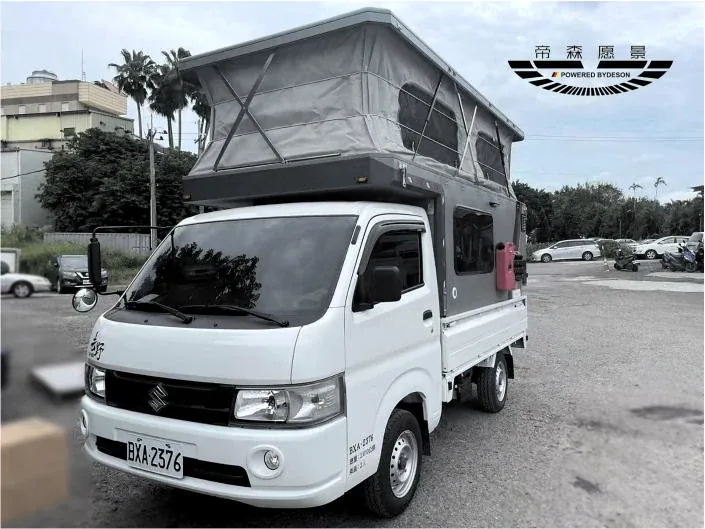
The base comes first, not the body
An importer building a camper range tends to start with the body: pop-top or hard-top, aluminium or FRP, how many berths, what equipment level. Buyers selling into utility, agricultural and commercial fleets have a decision sitting in front of that one — what the body is actually mounted to. Change the base and the specification changes underneath it, because the base decides the set of dimensions the body is built against.
Across most of the range the base is the pickup bed. The T1, T2 and T3 pop-tops, the T6 hard-fold body, the H1 and H2 hard-tops and the C1 and C2 canopy covers are all made to the bed dimensions of the vehicle you name. Mounting is bolt-on and non-destructive: nothing is cut or welded on the truck, and the unit can be taken out again when the truck changes.
Two models sit outside that pattern, and they exist because a large part of the world does not buy pickups with styled beds. The T4 flat-deck body is built for flatbed pickups and small commercial trucks rather than a standard bed. The T5 residence body is bolted directly to the pickup frame. Everything else about them — construction, equipment, exterior identity — follows the same order process as the rest of the range.
What a flat-deck base changes
The T4 starts from a flat platform instead of a shaped load box, and that single change runs through the whole specification. There are no bed walls to fit inside, so the body is larger, and the dimension that matters at the order stage is the flatbed rather than a bed. The roof section grows with the body, which is why electric lifting is the recommended choice on this model rather than an optional upgrade — manual lifting is still the default across the range, but the mechanism has to suit the roof section it raises.
- Made to the flatbed dimensions of the vehicle rather than pickup bed dimensions.
- Dual outward-pushing side windows as standard.
- Pop-top canvas roof section with four windows.
- Manual lifting as standard, with electric lifting recommended for the larger roof section.
- Optional drag-reduction roof box, plus body colour and decal scheme to your brand.
The commercial consequence is worth stating plainly: a flat-deck body is not a bed-mounted body with a different bracket. It suits a different buyer — utility and work-truck markets, agricultural dealers, tour operators running light trucks — and it is specified against a different vehicle drawing. If your market buys tray-style light trucks rather than styled pickups, this is the model in the range that answers it.
What a chassis-mounted base changes
The T5 takes the other route. It is the residence configuration: a large body bolted directly onto the pickup frame, for buyers who want a near-motorhome interior while keeping the truck. Fitment is made to the chassis and bed dimensions of the vehicle, so the mounting is a direct connection to the frame rather than a drop-in unit carried in a bed.
Because the body is the largest in the range, electric lifting is the recommended default configuration rather than an option. The body carries outward-pushing windows on both sides and a rear toolbox, and it is specified with the full equipment list, including the bathroom module. Reversibility is not lost by moving to the frame: the mounting is still bolt-on and non-destructive, with no cutting or welding of the vehicle, and the T5 mount is reversible in the same way as the bed-mounted bodies.
The three bases side by side
| Decision point | Bed-mounted bodies | Flat-deck body (T4) | Chassis-mounted body (T5) |
|---|---|---|---|
| Vehicle it suits | Pickups with a styled bed, from half-ton and mid-size to heavy-duty | Flatbed pickups and light commercial trucks | Pickups specified as the base for a residence body |
| What the body is made to | The bed dimensions of the named pickup | The flatbed dimensions | The chassis and bed dimensions |
| How it mounts | Bolts into the bed | Mounted to the flat-deck platform | Bolted directly to the pickup frame |
| Non-destructive mounting | Bolt-on — no cutting or welding of the vehicle | Bolt-on — no cutting or welding of the vehicle | Bolt-on to the frame — no cutting or welding, and the mount is reversible |
| Windows as standard | T1/T2 pair an outward-pushing window with a slide-out expansion compartment; T3 dual side windows; T6 windows in the roof section; H1/H2 two to three per side, adjustable | Dual outward-pushing side windows | Outward-pushing windows on both sides, plus a rear toolbox |
| Roof section and lifting | Manual with spring or hydraulic assist standard; electric optional on most models (T3 is manual only) | Manual default, with electric recommended for the larger roof section | Electric recommended as the default configuration |
| Who it is for | Dealers serving pickup owners; rental and tour fleets | Utility and work-truck markets, agricultural dealers and tour operators | Long-distance touring, premium dealer range and expedition outfits |
The lift mechanism follows the base
The lifting question is usually settled by the roof section, and the roof section grows with the body. On the bed-mounted pop-tops, manual lifting with spring or hydraulic assist is standard and entirely adequate for the smaller bodies, and electric scissor lifting is optional on most models. On the T4 flat-deck and the T5 residence bodies the roof section is larger and heavier, so electric lifting is the recommended configuration rather than an upgrade.
There is one exception worth knowing before a range is written: the T3 FRP pop-top is manual only. Electric lift and the expansion compartment are not offered on that model, so a buyer standardising one lift mechanism across a mixed range should settle the memory of that exception with the supplier rather than assume every pop-top can be configured the same way.
What to send with the vehicle list
- The vehicles: make, model and generation for every unit in the programme.
- The dimensions that match the base you are ordering — bed dimensions for bed-mounted bodies, flatbed dimensions for the T4, and chassis and bed dimensions for the T5.
- The base itself, stated explicitly: whether the vehicles are pickups with a styled bed or flatbed and light commercial trucks.
- Anything already fitted to the vehicle that affects the build, including deck height and existing mounting points.
- The destination market and the intended use, so the specification and the documents position can be confirmed against it before the order.
- The order volume and destination port, because the quotation is issued against the confirmed specification, quantity and destination port, and lead time is stated against that volume rather than as a fixed number of days.
Every body is custom-made to the vehicle data, which is why the same catalogue model can be a different unit in two markets. That is an advantage for a private-label range — one model can be positioned against light-truck fleets and another against pickup owners — but it also means the vehicle list belongs inside the written specification, alongside the equipment list and the exterior identity, rather than arriving in a later message.
A base-selection checklist
- Base named for every model in the order: pickup bed, flat deck or chassis.
- Vehicle list complete — make, model and generation for each unit.
- Correct dimensions supplied for that base: bed, flatbed, or chassis and bed.
- Lift mechanism confirmed against the roof section, remembering that electric is recommended on the T4 and T5 and is not offered on the T3.
- Reversibility position checked, if the fleet rotates vehicles between trucks.
- Equipment level, body colour and livery written into the same specification as the fitment data.
- Compliance documents position confirmed for the destination market against this exact configuration, before the order.
- Shipping format and destination port stated, so the quotation is issued against them.
The base is the least visible part of a camper order and the part that everything else is measured from. Name the vehicles, name the base, and the body length, the mounting type, the lift mechanism and the equipment list all follow from it. Send us the vehicles you sell into and the platform each body will sit on, and we will confirm the body against that data before you commit to a specification.