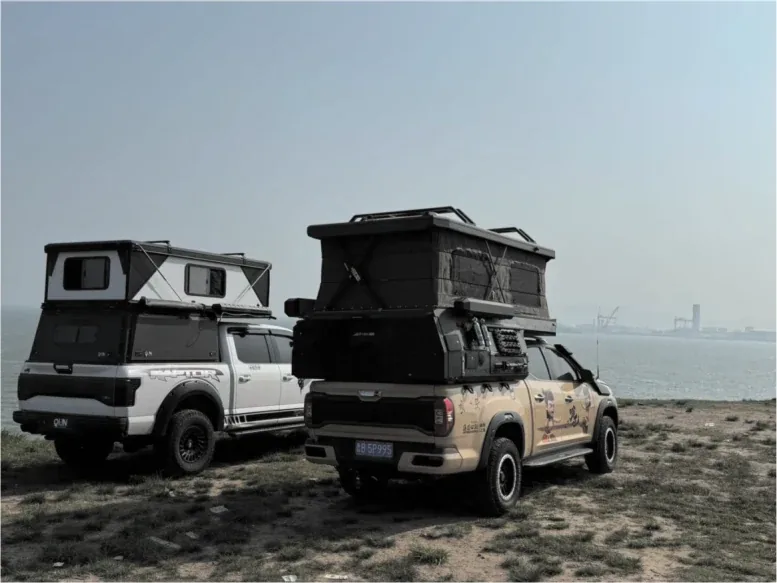
Why a fleet decision is not a retail decision
A retail buyer chooses one unit for one vehicle. A fleet operator chooses a unit that has to behave the same way on the twentieth hand-over as it did on the first. Because every body is made to its vehicle rather than selected from a fixed stock list, uniformity does not come from the catalogue — it comes from the decisions you settle before the first order.
Start with the vehicle list, not the model list
The body is made to the vehicle, so the vehicle list is the real starting point. Before models are discussed, collect for each unit:
- Make, model and generation.
- Bed dimensions for bed-mounted bodies, flatbed dimensions for the T4 flat-deck, or chassis dimensions for the T5 residence.
- Whether the vehicle is leased or owned, and whether it is replaced on a fixed cycle.
That last line matters more than it looks. Bodies across the pop-top and hard-top ranges use non-destructive bolt-on installation, so a unit mounts and comes off again without cutting or welding the truck. A fleet that rotates vehicles can move a body onto the next truck instead of selling the unit with the vehicle.
Standardise the lift mechanism
Manual lifting with spring or hydraulic assist is standard across the pop-top range. Electric scissor lifting is optional on most models and is the recommended configuration on the T4 flat-deck and T5 residence, where the roof section is larger and heavier.
For a fleet the question is not which system is better in the abstract, but whether to mix them. Two lifting systems in one fleet means two hand-over routines and two sets of spares held. Where the vehicle class allows it, one mechanism across the fleet is the simpler operation to run.
Standardise the equipment level
The interior is configured per order from the same options catalogue the retail range uses: roof air conditioning, bidirectional ventilation fan, vehicle fridge, combined sink and gas stove unit, bathroom module with shower and toilet, dinette systems, tables, lighting and monitoring displays.
For a rental fleet, split that list in two. Fixed items are fitted to every unit so the briefing is identical; optional items become an upgrade tier offered at the counter. Write both lists down before the order, because the equipment list forms part of the specification the units are built against.
Decide the spares position before the first container
Lift mechanisms, windows, hardware and service components come from the same production line as the complete units. A recommended spares kit ships with the first order, and further parts are supplied from the same line when the fleet needs them.
The practical decision is which components you want held against a fleet of your size, and where they are held. Settling that before the order is what turns a delivery into a serviceable fleet rather than a shipment that depends on the next container.
Write the hand-over routine down
The setup difference between the ranges is the hand-over difference. A pop-top unit has its roof raised and secured at camp with the canvas section deployed; a hard-top unit is ready to sleep in as soon as the door opens. Decide which routine you want your staff to teach, then choose the range that matches it — that decision is far harder to reverse once the fleet has been delivered.
What a first order can contain
MOQ is flexible and depends on the series and the shipping format, and mixed-model container loads are accepted. Roof-top tents ship as compact flat packs, so a first fleet order can combine camper bodies with tents for the same fleet. The model mix is therefore a planning decision rather than a constraint.
A fleet standardisation checklist
- Vehicle list complete, with bed, flatbed or chassis figures for every unit.
- One lift mechanism selected wherever the vehicle class allows it.
- Fixed equipment list written and the upgrade tier defined.
- Spares position agreed: which components, how many, held where.
- Hand-over routine written down and matched to a range.
- Model mix and shipping format planned together for the first load.
- Compliance documents for the destination market confirmed before the specification is frozen.