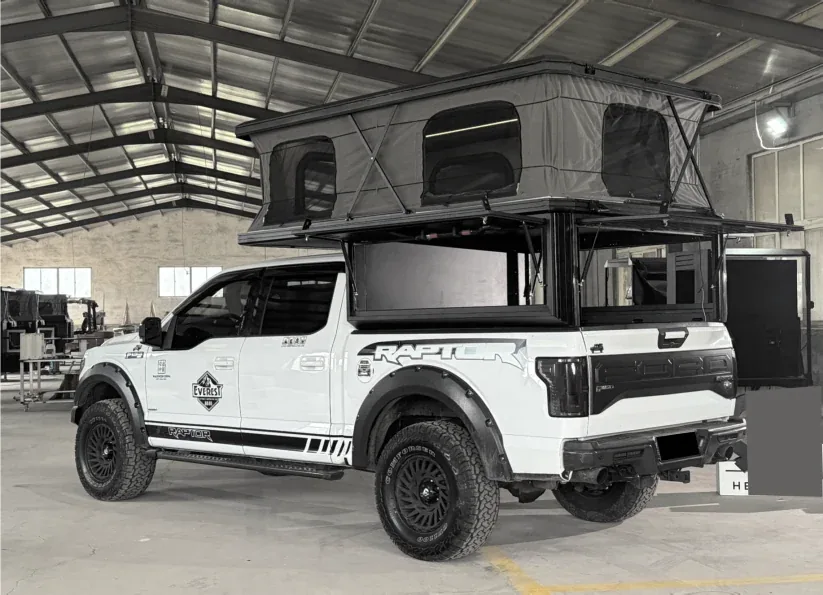
The decision is about the bed, not the roof
Two products in this range can put a sleeping area on the same dual-cab pickup, and buyers often compare them as if one were a better version of the other. They are not. A canopy camper keeps the bed as cargo space and puts the tent on the roof. A pop-top body takes the bed and builds the camper inside it. Everything that follows — what the truck is worth on a Monday, how the customer sets up at camp, what the interior can hold — comes from that one structural difference.
That makes the choice a question about the working life of the vehicle rather than about camping comfort: if the pickup carries tools or stock during the week, taking the bed out of service is a cost the buyer will feel; if it exists in order to go away in, an interior is the point and the bed is doing nothing else.
Canopy and pop-top on the same truck
The comparison stays structural: dimensions, weights and payload figures are confirmed against the vehicle before an order.
| Decision point | Canopy camper (C1 and C2) | Pop-top body (T range) |
|---|---|---|
| Pickup bed | Stays cargo space — the aluminium high cover closes over the load area | Taken by the body, which bolts into the bed and occupies it |
| Where the sleeping area sits | On the roof, in a folding tent that opens to four side windows | Inside the body, with the bed made up while the roof is raised |
| Roof element | C1 rigid FRP folding shell or C2 high-density waterproof canvas | Pop-top canvas with four windows; the T6 uses a hard-shell folding roof |
| Headroom | Standing height belongs to the tent above the canopy, not to the cargo area | Opening the roof gives full standing headroom inside the body |
| Interior fit-out | Interior lighting as an option; outdoor shower and side awning recommended for camping | Layout, dinette, kitchen, water and power configured per order from the options catalogue |
| Cargo in use | Lockable, weatherproof space under the cover — the working-week argument | Interior and equipment fill the bed; cargo has to travel elsewhere |
| Windows | Wing windows on left, right and rear of the canopy | Outward-pushing windows, plus an expansion compartment on the T1 and T2 |
| Mounting | Mounted on the pickup bed as a high canopy | Bolt-on in the bed, non-destructive, made to bed or chassis dimensions |
| Construction | All-aluminium canopy on both models | Welded all-aluminium on T1, T2 and T6; FRP sandwich composite on T3 |
| Buyer it serves | Trade, utility and dual-use buyers who work the truck first | Buyers who want a camper with an interior for touring, rental or family use |
What the canopy range actually is
The canopy is an all-aluminium high cover with wing windows on the left, right and rear, mounted on the bed. The roof carries the folding tent — rigid FRP on the C1, high-density waterproof canvas on the C2 — and both open to four side windows. That is the product: a lockable, weatherproof cover over the load area with a sleeping unit built into the top of it.
It matters just as much to be clear about what it is not. The canopy does not create an interior: there is no dinette, no kitchen block and no bathroom inside a canopy unit, and the space under the cover is cargo space first. Interior lighting is an option, and an outdoor shower and side awning are the documented camping additions — the right fit-out for a vehicle whose main job is work.
C1 or C2: the split inside the range
- C1 High-Cover Hard-Roof Tent — all-aluminium canopy carrying a rigid FRP folding roof tent, the more secure and better-insulated roof of the two.
- C2 High-Cover Soft-Roof Tent — the same canopy and window layout with a high-density waterproof canvas tent, a lighter roof pack and the more accessible position in the range.
- Shared on both — wing windows on left, right and rear, four side windows when raised, optional interior lighting, outdoor shower and side awning, canopy colour to your brand.
What a pop-top body buys instead
A pop-top body bolts into the bed and stays there. The roof lifts at camp — manual with spring or hydraulic assist is standard, electric is optional on most models and recommended on the T4 flat-deck and T5 residence bodies — and with the canvas section open the body gives full standing headroom while the bed stays made up. The T6 takes the same idea further with a hard-shell folding roof in place of canvas.
The value is the interior. Layout, berth arrangement, dinette, kitchen, water and power are configured per order from the options catalogue, from a simple two-berth layout to a unit with a bathroom module, hot water and a compressor fridge. That is what a touring customer pays for, and it is exactly what a canopy leaves out.
Where the dual-use argument breaks down
The dual-use pitch is strong but has an edge. Three buyers are not served by a canopy:
- A customer who wants to stand up and cook inside on a wet evening — headroom and living space are in the body, not above a canopy.
- A family touring for a week or more, where kitchen, fridge, water and bathroom need an interior to live in.
- A hire fleet whose guests expect accommodation rather than a covered load bed, because hand-over expectations are set by the product.
The reverse case is just as clear. A landscaper or a stock agent who loads the truck every working day does not want to strip a camper body off to carry a pallet, and does not want a second vehicle for weekends. For that buyer the canopy is the only unit in the range that works on Monday and on Saturday without a decision in between.
Both products come off the same line
The argument for stocking both is that the choice does not split the supplier relationship. Aluminium and FRP production sit side by side in one plant, full-pickup customisation applies to either product, and colour, livery and branding are set per order — so a dealer can hold the canopy at the trade counter and the pop-top range for the touring customer without a second supply chain.
The order mechanics are shared too: MOQ is flexible and depends on the series and shipping format, mixed-model container loads are accepted, and a first order can combine bodies with roof-top tents. Compliance documents are confirmed against the destination market, and price and lead time are quoted per order volume, model mix and destination port.
Selection checklist
- Ask what the truck carries on a working day. Tools, stock or equipment points to the canopy range; a vehicle bought for travel points to a body.
- Ask where the customer expects to stand, cook and sit. If the answer is inside, the canopy is out and the decision moves to pop-top or hard-top.
- For a canopy order, choose C1 or C2 by roof-tent shell: rigid FRP for security and insulation, canvas for the lighter roof pack.
- For a pop-top order, confirm the lift against the model — manual is standard, electric is recommended on the T4 and T5.
- Send the vehicle details: make, model, generation and bed or chassis dimensions, since both products are made to the specific vehicle.
- Agree the fit-out list in writing: canopy units take lighting plus shower and awning, bodies take the interior equipment list.
- Fix the exterior identity and approve the artwork before production, then confirm the compliance documents against the destination market.