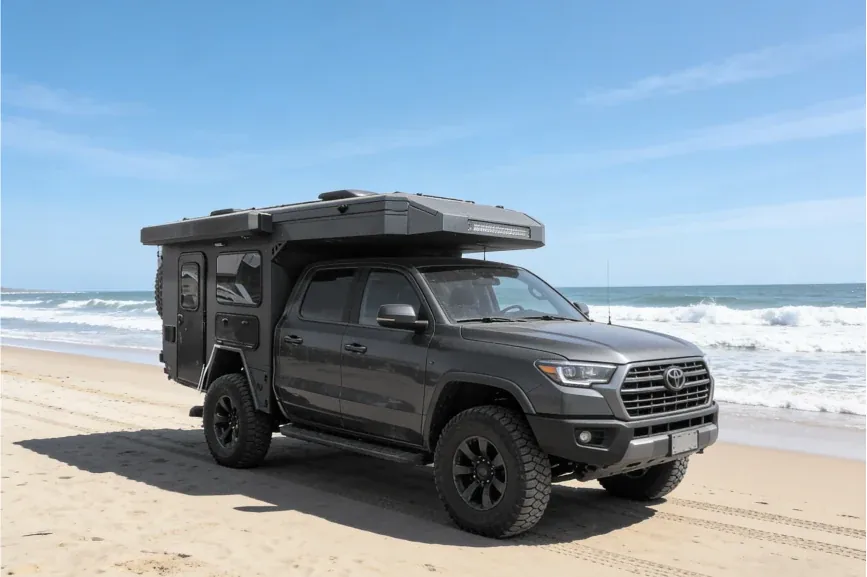
The one difference that decides most orders
A pop-top body keeps the truck a truck. The roof travels down, so the vehicle stays low on the road, and the body opens at camp into standing headroom with the bed still made up. A hard-top body gives you that headroom permanently: nothing deploys, and the unit is ready to sleep in as soon as the customer stops.
That single difference drives almost everything else in the decision. Pop-top buyers are usually people who drive the same vehicle every day and go away at weekends. Hard-top buyers usually want to arrive and be done — and, in colder or wetter markets, they are served by dealers who would rather not sell canvas as a maintenance item.
Side by side
| Decision point | Pop-top range (T1–T6) | Hard-top range (H1–H2) |
|---|---|---|
| Travel height | Roof lowers for the road; low profile while travelling | Fixed full-height body; overall height is constant |
| Setup at camp | Roof is raised and secured, then the canvas section is deployed | No setup — open the door |
| Headroom | Standing headroom with the roof raised | Standing headroom at all times |
| Roof section | Soft canvas on most models; hard-shell folding roof on the T6 | Fixed rigid roof with no lifting mechanism |
| Body material | Welded all-aluminium (T1, T2, T6) or FRP sandwich composite (T3), plus flat-deck (T4) and frame-mounted residence (T5) variants | FRP sandwich panels (H1) or one-piece bent and welded aluminium (H2) |
| Lift mechanism | Manual with spring or hydraulic assist as standard; electric optional on most models and recommended on the T4 and T5 | Not applicable |
| Typical fit | Half-ton and mid-size pickup markets; rental and tour fleets that need fast hand-over | Cold and wet climates; zero-setup buyers; fleets that want the simplest hand-over |
Match the body to the climate your dealers sell in
Canvas is the variable. In a dry, warm market it is a non-issue: it dries fast, and nobody asks about it at the point of sale. In a market with a long wet season or hard winters, the same canvas becomes something the dealer has to explain, clean and eventually replace — and a fixed roof removes that conversation entirely.
The hard-top range exists as two constructions rather than one because of that. The H1 uses FRP sandwich panels with an insulated core and a smooth painted finish, which suits a conventional retail line. The H2 is bent and welded as a single aluminium body, for buyers who position the product as technical or off-road equipment. Both use the same window approach: two to three outward-pushing windows per side, with the count agreed when the order is placed rather than fixed by the model.
Match the body to the customer's routine
Rental and tour fleets are the clearest case. A pop-top unit hands over quickly once the routine is written down, and its lower travel height matters when the fleet shares car parks, ferries and tunnels. A hard-top unit removes the hand-over briefing almost completely, which matters more when staff turnover is high or the customer is a first-time camper.
The T6 sits between the two positions: an aircraft-grade aluminium body with a hard-shell folding roof. It behaves like a pop-top on the road, but the lifting section is a rigid insulated shell rather than fabric, so the weather and maintenance arguments are reduced without giving up the low travel height.
What does not change between the two ranges
- Fitment. Every body is custom-made to the bed — or, on the T5 residence, to the chassis. Both ranges use non-destructive bolt-on installation, so a body mounts and comes off again without cutting or welding the truck.
- Equipment. The interior is configured per order from the same options catalogue: roof air conditioning, ventilation fan, vehicle fridge, combined sink and gas stove unit, bathroom module, dinette systems, lighting and monitoring displays.
- Parts. Lift mechanisms, windows, hardware and service components come from the same production line as the complete units, so a delivered fleet stays serviceable.
- Branding. Body colour, livery, decals and window count are set per order under an OEM or ODM programme, with artwork approved in writing before production starts.
What to confirm before you commit to a range
- The vehicles. Collect the make, model, generation and bed dimensions for every pickup you intend to serve. The T4 needs flatbed dimensions, and the T5 needs chassis dimensions rather than bed dimensions.
- The climate and the routine. Decide whether canvas is acceptable in your market, and write down what the hand-over looks like for any rental or fleet customer.
- The equipment level. Agree the interior against the options catalogue so that the written specification and the quotation describe the same unit.
- The shipping format. Pop-top bodies, hard-top bodies and roof-top tents containerise differently, so the model mix affects how a first order is loaded.
- The compliance set. Requirements differ by product and by destination market — confirm which documents can be supplied for the configuration before the specification is frozen.
A short selection checklist
- Customer keeps the truck as a daily driver and travels at weekends — start with the pop-top range.
- Customer wants to stop and sleep with no setup, or the market has long wet seasons — start with the hard-top range.
- The range needs an entry price point — the T3 FRP pop-top is specified as the value model in the pop-top range.
- Flatbed pickup or light commercial truck — the T4 flat-deck pop-top.
- Near-motorhome interior on a pickup chassis — the T5 residence pop-top.
- Low travel height without a canvas roof — the T6 hard-fold pop-top.
- Rental or tour fleet — decide the hand-over routine first, then pick the range that matches it.