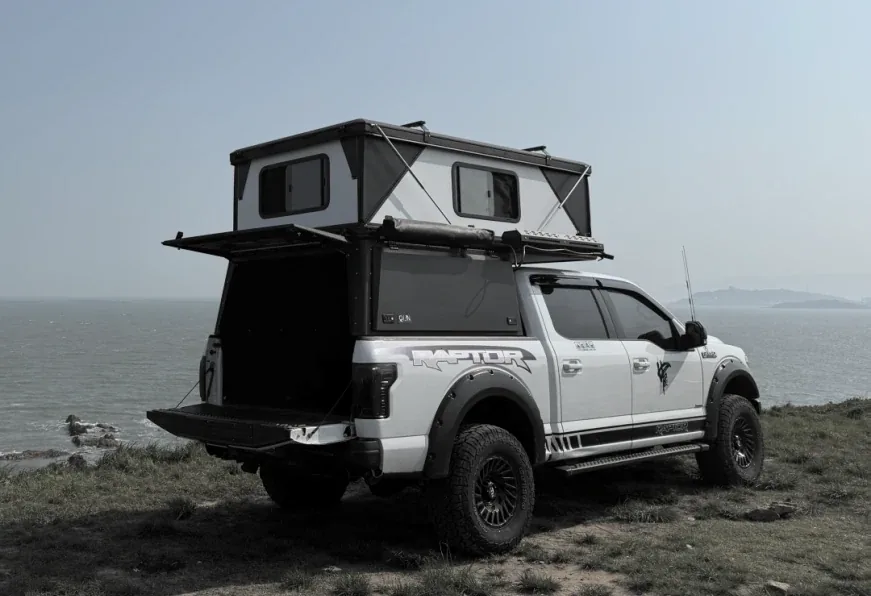
Two buyers, one product
Most camper products ask a dealer to pick a customer. A pop-top body is for the trip, a hard-top is for the season, a roof tent is for the accessory counter. The canopy range is the exception: it is built for the customer who uses the truck for work and does not want a second vehicle for the weekend.
The canopy is an all-aluminium high cover with wing windows on three sides — lockable, weatherproof cargo space that does its job Monday to Friday. Built into the roof of that same cover is a folding tent. Open it and the vehicle sleeps. That dual role is not a gimmick bolted onto a cargo box; it is the reason the product sells into trade and utility markets, where the buyer justifies the purchase as equipment — a canopy they need, that also camps.
What the canopy range actually is
The canopy is a high cover mounted on the pickup bed. The shell is all-aluminium, with wing windows on the left, right and rear. Inside, it does the ordinary job of a canopy: dry, lockable storage for tools, equipment or cargo, sealed against the weather.
The roof is where the second product lives. Both versions carry a folding tent that opens upward, and both open to four side windows when raised. Interior lighting can be fitted, and an outdoor shower and side awning are the recommended camping additions. The exterior finish is set to your brand, so the unit can arrive as your product rather than a catalogue model.
Two roof-tent versions: C1 and C2
The range splits on one decision — the roof tent itself. Everything below the roof is shared; the choice is how the sleeping section is built.
| Feature | C1 — hard-shell roof tent | C2 — canvas roof tent |
|---|---|---|
| Canopy shell | All-aluminium high cover | All-aluminium high cover |
| Canopy windows | Wing windows, left / right / rear | Wing windows, left / right / rear |
| Roof tent | Rigid FRP hard-shell folding tent | High-density waterproof outdoor canvas |
| Tent windows | Four side windows when raised | Four side windows when raised |
| Roof pack | Rigid shell that folds as a hard cover | Folds into a compact pack on the roof |
| Positioning | More secure and more insulating | Lighter and more price-accessible |
| Optional fit-out | Interior lighting; outdoor shower and side awning | Interior lighting; outdoor shower and side tent or awning |
For a trade buyer the C1 reads as equipment: a hard shell that locks and insulates, closer in feel to a fitted service body. For a value-led market the C2 does the same job with a canvas tent that packs down smaller and lands at a lower price point. Neither is a downgrade of the other — they are the same canopy with a different roof decision, which is exactly the choice a dealer wants to put in front of a customer.
The trade buyer: cargo first, camping second
The first buyer arrives asking about the canopy, not the camper. They run a trade or a utility vehicle, they need the bed covered and lockable, and the words roof tent are either a pleasant surprise or a second use they had not considered.
Lead with the working half. Ask about the working week before mentioning the weekend and the product lands as a tool the customer already needs: all-aluminium shell, lockable, wing windows for access, sealed against weather. The tent then becomes the closing argument rather than the opening one — an upgrade with no second vehicle to buy and no trailer to store, because the same truck that carries the tools sleeps two.
The dual-use buyer: one vehicle, two jobs
The second buyer is the one who says they want it for both. They tow, they travel, they camp, and they do not want a camper that ties the truck up. This is the buyer the canopy range is built around, because the two functions share the same vehicle honestly rather than by compromise.
There is no tent to pitch on the ground and no trailer to reverse. The unit sits on the bed, the tent folds out of the roof, and the vehicle stays a vehicle the rest of the time. At the counter that is a simpler story than any camper in the range: nothing is added to the truck footprint, and nothing is left behind at the campsite.
Where the fit-out decisions sit
The construction and the mounting type are fixed by the model; the decisions that follow are the ones the customer makes with the dealer. Window layout is standard across the range — wing windows left, right and rear — while the raised tent opens on four sides. Above that, interior lighting is an option, and the camping fit-out, an outdoor shower and side awning, is the recommended addition for buyers who intend to sleep in it.
For private-label dealers the exterior is set per order: body colour to the brand, graphic livery and window count confirmed in writing before production. The canopy is therefore not only a product to stock but a product to badge — the same cover, presented under the dealer name in the dealer market.
A short evaluation checklist for dealers
- Decide which buyer you are opening the range for: trade, sold canopy-first, or dual-use, sold as one vehicle for two jobs.
- Choose the roof tent as the primary decision — C1 hard shell for security and insulation, C2 canvas for roof pack weight and price point.
- Confirm the canopy window layout suits the customer access needs: wing windows left, right and rear are standard.
- Plan the fit-out with the order: interior lighting as an option, outdoor shower and side awning for camping use.
- Set the exterior identity if you sell under your own brand — colour and livery are confirmed in writing with the specification.
- Confirm fitment against the actual vehicle: the canopy mounts on the pickup bed, and the vehicle data is checked before the order.
- Ask what ships with the first order and how a mixed load is planned, since the canopy can travel in the same container as the other models.
Run the canopy range as one product with two buyers and the trade conversation and the leisure conversation stop competing for shelf space — they sell off the same unit. If you want the range mapped to your market, send the buyer you are opening with and the vehicle types you sell into, and we will put the model and the options in writing.