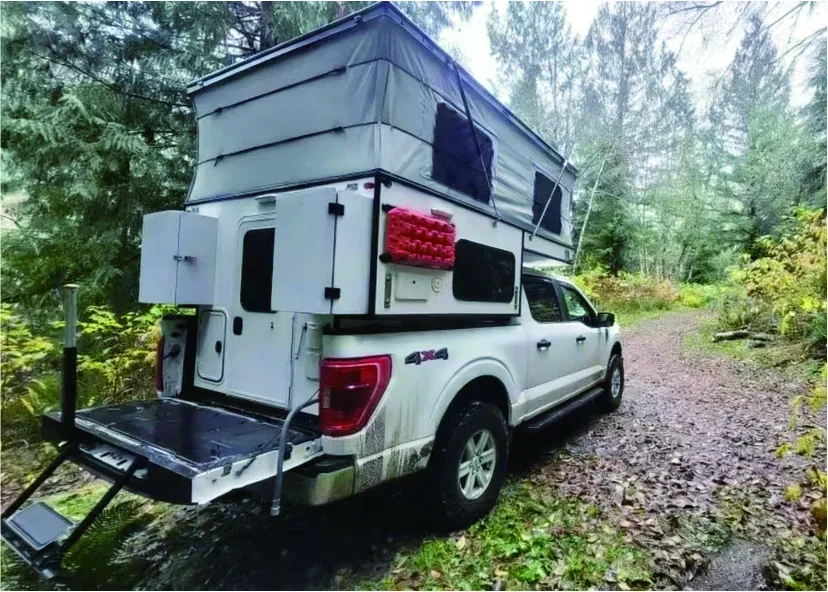
Most buyers pick the model first and ask about climate second
The order is usually the other way round. A dealer chooses the body that suits the trucks in the yard, then asks whether it will hold up in the market. The documented range reads better in reverse: the destination climate sets four requirements, and the model that answers all four is the one to specify.
Those four requirements are the roof over the sleeping area, the wall and roof assembly around it, the air movement through the cabin, and how much of the unit is expected to live outdoors. Each is answered by something concrete in the catalogue — a roof type, a construction route, a ventilation item, an awning — which is why the climate conversation can be had without quoting a single performance figure.
Four climate profiles, four different demands
| Climate profile | Primary demand on the body | Documented configurations that answer it |
|---|---|---|
| Cold winters, long heating season | A roof that does not depend on fabric overnight, and a wall and roof build with an insulated core | H1 FRP hard-top (insulated core, fixed roof); T6 hard-fold (insulated hard-shell roof section, recorded for four-season retail); T3 FRP pop-top where a lifting roof is required |
| Long wet season, coastal humidity | The smallest practical fabric area, and a body that sheds water rather than holding it | H1 or H2 hard-top — fixed roof, no lifting mechanism; T6 where the lifting section must be a rigid shell; C1 rather than C2 where a canopy is the product |
| Hot, dry, high sun | Shade and airflow ahead of insulation, and a market that accepts canvas as a wear item | Pop-top T1 to T5 with canvas windows and a 270° awning; top-mounted or split-system air conditioning; window count per side on H1 and H2 |
| Temperate or shoulder-season, mixed use | One unit that serves a hot week and a cold one without giving up low travel height | T6 as the compromise; a pop-top with additional canvas windows and ventilation; a hard-top where zero setup outranks the travel profile |
Two of those rows are judgement calls the buyer makes, not facts the catalogue states. Whether a market tolerates canvas, and how much shade a retail customer expects, are commercial readings of the destination. The catalogue supplies the other half: which configurations take fabric off the roof, which carry an insulated core, and which items move air through the cabin.
What the construction routes actually decide
The range runs on two body production routes and two roof principles. The climate decision falls out of how they combine, which is why the same market can be served two different ways.
- FRP sandwich composite — T3 and H1. Panels with an insulated core and a smooth painted finish. The H1 is the body recorded for cold-climate retail; the T3 applies the same material at a value position, with manual lift and no expansion compartment.
- Welded all-aluminium — T1, T2, the T6 body, H2, and both canopy covers. One-piece welded construction, described as high rigidity and low weight. It appears in fixed (H2) and lifting (T1, T2) formats, so it is a material decision rather than a roof decision.
- Canvas roof section — T1 to T5 pop-tops and the C2 tent. This is the reason the pop-top exists: a low travel height that clears garages and car washes. The fabric section is also the part of the unit the buyer is choosing to maintain.
- Hard-shell roof section — T6 and C1. A rigid shell that lifts. The documentation describes the T6 roof as insulated and states that it needs no fabric maintenance; the C1 applies the same principle at canopy scale, in a rigid FRP tent rather than canvas.
Read together, those four lines explain why the range is not a ladder from cheap to expensive. A buyer can have a fixed roof in composite or in aluminium, or a lifting roof in canvas or in hard shell, and each combination answers a different climate brief at a different market position.
The T6 answers a precise question, not a universal one
The T6 is the model buyers most often misread. It is a pop-top: the roof still travels down for the road and is still raised at camp. What changes is the material of the lifting section — a rigid insulated shell instead of fabric. So it answers the brief that says low travel height is non-negotiable and canvas is not acceptable, and it is recorded for four-season retail, premium rental and expedition use.
It does not replace a hard-top. Where the requirement is that nothing deploys when the customer stops, the H1 or the H2 is the body that meets it. Both statements sit in the catalogue, and the choice between them is a question about the customer rather than about the product.
Three climate decisions the model name does not settle
- Window count. On the H1 and H2 it is two to three outward-pushing windows per side, agreed when the order is placed. In a hot market that is the most direct airflow decision available; in a cold one it is a heat-loss decision. Neither is fixed by choosing the model.
- Air conditioning. Two routes are catalogued — a top-mounted roof unit and a split system with an outdoor condenser. Which one suits depends on the roof equipment planned and on how the market uses the unit, so it belongs in the specification rather than in a later request.
- Ventilation inside the cabin. A bidirectional exhaust fan and additional canvas windows are catalogue items. On a pop-top they are how humid air leaves the living space; on a hard-top they are the difference between a sealed box and a ventilated one.
Put the climate in the specification, not in the model name
Every order runs through the same first stage whatever the destination: the buyer sends the pickup details, the target market and the equipment list, and a written specification naming the model and the options comes back. The climate belongs in that exchange as a sentence — for example that the units are for a market with a long wet season and that no fabric roof is acceptable — because that document is what the quotation, the production records and the pre-shipment inspection are checked against.
Two things travel with it. Compliance documents are confirmed against the destination market for each configuration before the order, and they are not something a model name settles on its own. And a climate requirement is not a reason to expect different commercial terms: price and lead time are quoted against order volume and destination, as for any other specification.
Specifying a range for climate: the checklist
- Name the climate profile of each market you sell into, in one sentence, before looking at models
- Decide the roof principle first: fixed roof, lifting canvas, or lifting hard shell
- Choose the construction route second: FRP sandwich with an insulated core, or welded aluminium
- Move the airflow decisions into the specification — window count per side, air-conditioning route, exhaust fan, canvas windows
- Check the camp kit against the climate: an awning for sun, a shower tent where the wet functions stay outside the body
- Write the climate requirement and the compliance position into the first submission, and confirm both in the returned specification
A range specified by climate reads as a coherent line to a dealer and as a defensible one to a distributor, because every model has a reason to be there. If you are building that line, send the destination markets and the vehicle list through the contact page, and the climate requirement is turned into a written specification naming the models and options that answer it.