The short answer
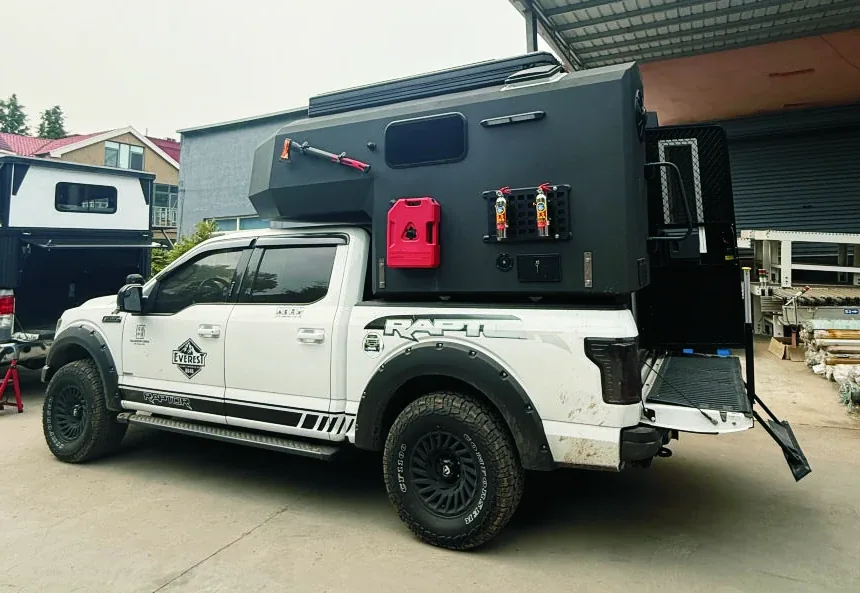
Material is not a quality ranking. It is a set of consequences. The all-aluminium bodies in the range — the T1, T2 and T6 in the pop-top series, the H2 in the hard-top series, and the canopy range — are welded as one structure. The FRP bodies, the T3 and the H1, are built from a fiberglass sandwich composite with an insulated core and a smooth painted surface. Both routes come out of the same factory, and both are used across price points in the range.
So the useful question for a dealer or an importer is not which one is better. It is which set of consequences suits the customers, the climate and the service network you are selling into. The site's positioning is deliberately neutral on this: aluminium and FRP sandwich production sit side by side, so the construction is an engineering choice per model rather than a limitation of the factory.
Where it is decided in the range
If you already know which range you are stocking, the material question is partly answered for you. The pop-top range runs from the T1 off-road sloping body through the T2 flat-front, the T3 FRP value model, the T4 flat-deck and the T5 residence. The hard-top range offers the H1 in FRP sandwich panels and the H2 in one-piece bending and welding. The canopy range is all-aluminium.
| Route | Where it appears | What it is | Positioning it suits |
|---|---|---|---|
| Welded all-aluminium | T1, T2, T6 (pop-top); H2 (hard-top); C1, C2 (canopy) | Integrated welded structure, one-piece where the model allows | Technical, off-road and work-truck positioning |
| FRP sandwich composite | T3 (pop-top); H1 (hard-top) | Sandwich panels with an insulated core and a smooth painted finish | Conventional retail lines and price-led positions |
| Aircraft-grade aluminium with a hard roof | T6 (pop-top) | Aluminium body under a hard-shell folding roof section | Four-season retail and premium rental |
Thermal behaviour: the one that reaches the customer
This is where the specification stops being abstract. The FRP route is described in the range as a sandwich with an insulated core, and that core is what a customer feels in a cold morning or a hot afternoon. It is the reason FRP suits dealers in markets with a long shoulder season, where the difference between a body that holds its temperature and one that does not is a complaint at the counter rather than a specification note.
The T6 takes a different route to the same outcome: an aircraft-grade aluminium body paired with an insulated hard-shell roof section, so the body stays metal while the roof provides the insulation and the security of a rigid shell rather than fabric. For a market that buys four-season capability, that combination — rather than the body panel alone — is the specification to sell on.
What the site does not publish is a comparative thermal figure for either route. Insulation performance by construction is not documented yet, so treat any claim you make about it as something to confirm with the factory against your own configuration rather than something to copy from a brochure.
Finish, repair and the service network behind it
The two routes age differently, and that decides what your dealer network is signing up to maintain. FRP gives a smooth painted surface over the whole body, which reads as a conventional white-goods caravan finish to a retail customer and takes body colour and livery the way a painted panel does. Welded aluminium is a fabricated, visibly structural surface, which reads as equipment rather than appliance — the right language for overland and work-truck buyers.
Those are the two descriptions the range supports. What it does not yet document is the repair procedure for each: how a damaged panel is repaired in the field, whether a section can be replaced without disturbing the structure, and what a dealer would need to hold to do it. A dealer selling off-road vehicles into a remote catchment should ask that question directly, because the answer affects both the parts position and the warranty conversation.
- Ask which service components for the chosen construction come from the same production line as the unit.
- Ask what a recommended spares kit contains for that construction and what it is sized against.
- Ask how an exterior panel is repaired or replaced, and whether that is a dealer-level or factory-level task.
- Ask what the finish requires over the life of the unit in your market's climate.
Weight and payload: the limit that bites on the vehicle side
This is the risk that catches importers out, and it is not a material-versus-material question. The vehicle has a payload limit, and the body plus the interior equipment plus water and gear all sit against it. The T1 is described as an integrated welded all-aluminium body chosen for high rigidity and low weight; the T6 uses an aircraft-grade aluminium structure described as light and rigid; the T4 and T5 have a larger roof section and heavier body, which is why electric lifting is the recommended configuration on those two models.
The practical sequence is therefore: confirm the vehicle class and its payload, confirm the body that fits it, and only then finalise the interior equipment list. Doing it the other way round — choosing the equipment first and discovering the payload afterwards — is the version of this that goes wrong.
What does not change with the material
- Mounting. Every body in the pop-top and hard-top ranges uses non-destructive bolt-on installation, so the unit mounts and comes off again without cutting or welding the truck. A fleet that rotates vehicles can move a body onto the next truck.
- Fitment. The body is custom-made to the vehicle — bed dimensions for bed-mounted bodies, flatbed dimensions for the T4, chassis dimensions for the T5 — whichever construction you choose.
- Equipment. The interior is configured per order from the same options catalogue: roof air conditioning, bidirectional fan, vehicle fridge, combined sink and gas stove unit, bathroom module, dinette systems, tables, lighting and monitoring displays.
- Windows. Dual or multiple outward-pushing side windows are fitted across the range; on the hard-top models the count per side is agreed when the order is placed rather than fixed by the model.
- Branding. Body colour, livery, decals and window count are set per order under an OEM or ODM programme, with artwork approved in writing before production.
A specification checklist for the material decision
- Write down the climate the range will be sold into, including the shoulder seasons rather than the best week of summer.
- Decide whether your customers read the product as equipment or as a caravan — that is which finish language you are selling.
- Confirm which construction the models you have shortlisted actually use, since the two routes are split across different models in the same series.
- Check the vehicle payload against the body and the intended equipment before the interior list is finalised.
- Ask the repair, panel-replacement and spares questions for the construction you are choosing, and write the answers into your dealer materials.
- Confirm which compliance documents can be supplied for the configuration before the specification is frozen.
- Confirm the construction at the same time as the model, not after — the two cannot be swapped on a finished body.