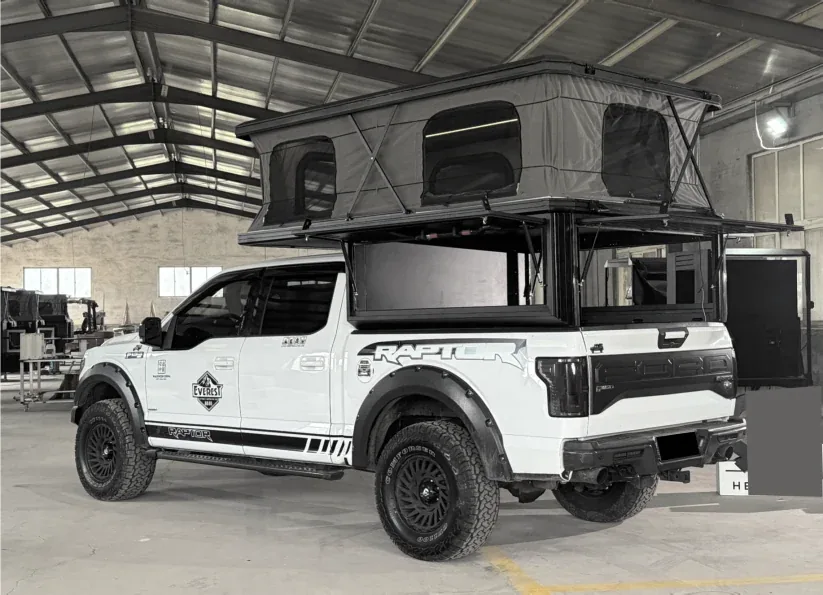
The most under-read list on a product page
A camper model page carries a lot of specification: body material, roof principle, lift mechanism, window layout, storage, options. Near the bottom sits a much shorter list that is easy to scroll past — applications. Every model in the TUYU catalogue carries three recorded applications, and no two models carry the same set.
Read one at a time, the applications look like a footnote. Read across all twelve models, they are the factory's own positioning record: which buyer each body was drawn for, at which shelf it is expected to sit, and which models deliberately share a position. For a dealer building a range, or a private-label brand choosing which body to put a new brand on, that map is worth reading before any specification is written.
The applications map, model by model
The table below quotes the applications exactly as recorded against each model, alongside the construction fact that anchors it.
| Model | Construction and roof principle | Recorded applications |
|---|---|---|
| T1 | Welded all-aluminium, sloping front, pop-top canvas | Overland retail, adventure rental, off-road dealer range |
| T2 | Welded all-aluminium, flat front, pop-top canvas | Dealer main range, family touring, rental fleet |
| T3 | FRP sandwich composite, pop-top canvas, manual lift only | Entry dealer range, first-time camper buyers, price-led markets |
| T4 | Flat-deck body for flatbed pickups and light trucks | Utility and work-truck markets, agricultural dealers, tour operators |
| T5 | Largest body, bolted directly to the pickup frame | Long-distance touring, premium dealer range, expedition outfits |
| T6 | Aircraft-grade aluminium, hard-shell folding roof | Four-season retail, premium rental, expedition market |
| H1 | FRP sandwich panels, fixed hard-top | Cold-climate retail, four-season touring, dealer premium range |
| H2 | One-piece bent and welded aluminium, fixed hard-top | Off-road retail, technical/expedition market, dealer premium range |
| C1 | All-aluminium canopy, rigid FRP roof tent | Trade and work-truck retail, overland market, dual-use buyers |
| C2 | All-aluminium canopy, waterproof canvas roof tent | Trade and work-truck retail, value market, dual-use buyers |
| R1 | Hard-shell roof-top tent, design A | Outdoor retail, 4x4 accessory stores, mixed container loads |
| R2 | Hard-shell roof-top tent, design B | Outdoor retail, 4x4 accessory stores, mixed container loads |
What the map shows when you read across it
Three patterns in the arrays matter for range planning:
- A retail ladder is already drawn. Entry sits at T3 — entry dealer range, first-time camper buyers, price-led markets. The main range sits at T2 — dealer main range, family touring. Premium sits at T5, T6, H1 and H2, all four recorded with premium dealer range, four-season or expedition language.
- Rental appears at three altitudes. The T2 is recorded for rental fleet, the T1 for adventure rental and the T6 for premium rental — the same channel at three different positions, matched to three different constructions.
- The trade and dual-use shelf belongs to the canopy. C1 and C2 carry identical trade, work-truck and dual-use applications; the recorded difference between them is the market they lean toward — overland market on C1, value market on C2.
The roof-tent line reads differently again. R1 and R2 are the only models whose applications are written as channels rather than end uses — outdoor retail, 4x4 accessory stores, mixed container loads — which reflects what the product is: a tent that mounts to any vehicle with a roof rack or crossbars, not a body made for a pickup bed.
One body, three markets: what the arrays actually separate
The T2 is the cleanest example of why this matters. One welded all-aluminium flat-front body is recorded for three different buyers: the dealer stocking a main range, the family buying for touring, and the rental operator handing the same unit from customer to customer. The body does not change between those three. The order does — equipment level, lift mechanism, exterior colour and decal scheme are configured per order, and the catalogue model defines the construction while the identity and fit-out follow the buyer.
That is the practical meaning of one body, three markets: the applications array separates the product from the market position, and the per-order configuration is what moves a single model between the positions it is recorded for. The C1 and C2 show the same principle from the other direction — two canopies that share almost their whole applications list and are separated into overland and value positions by one documented difference: a rigid FRP tent shell versus a high-density waterproof canvas tent.
Using the map before the specification
- List the applications that match your customer base — end uses such as family touring or expedition, or channels such as accessory retail.
- Shortlist the models whose recorded applications cover them; the table above is the full set.
- Read the construction line of each shortlisted model — aluminium or FRP sandwich, pop-top canvas or hard shell — because construction, not a price list, is what justifies the position.
- Decide what varies within the model: equipment level, lift mechanism, exterior colour and decal scheme are configured per order.
- Send the market, the vehicle list and the intended application at process stage 01, so the written specification names the model and the options that apply.
- Treat the applications as positioning, not demand data — they tell you where a model is meant to sell, not how many will sell.
For RV and 4x4 dealer buyers, the same logic scales to the whole shelf: the range is described as retail-ready units across pop-top, hard-top, canopy and roof-tent price points, without a second supplier. Price and lead time sit outside the map entirely — they are quoted against the confirmed specification, the order volume and the destination port.